

Every time I have a consulting session with new clients in Nigeria, I often receive questions from business owners or marketing managers, such as:
“David, which digital marketing tools should we start using now?”
My response always begins the same way:
“First, tell me what you are trying to achieve.”
This is the key to selecting the best digital marketing tools. There is an important fact that many articles on this topic often overlook this; even the best tool will not help grow your business if it is misused or part of an ineffective strategy.
Tools are designed to enhance your workflow and make your tasks easier, contributing to greater effectiveness. If your strategy is unclear, simply adopting a better tool will not solve the problem; it will only exacerbate poor outcomes.
However, once your strategy is clearly defined, the right digital marketing tools can make a significant impact. They can save you time, reduce costs, improve consistency, and provide valuable data for informed decision-making.
This article is not just a list of tools; it is a practical guide to understanding the purpose of each category of tools. It aims to help you identify which specific tools are worth your investment in the Nigerian market for 2026 and to create a toolset that aligns with your business type and budget without incurring costs for unnecessary services.
Why Nigerian Businesses Need to Be More Strategic in Tool Selection for 2026
The digital marketing tools market has exploded in the last three years.
There are now more platforms, software solutions, and automation tools available to Nigerian businesses than ever before. Many of them are genuinely useful. Some of them are excellent. And a fair number of them are expensive subscriptions that look impressive in a pitch deck but sit largely unused after the first two weeks.
The challenge for most Nigerian entrepreneurs and marketing teams is not access; it is clarity: how can I effectively use this tool to achieve my task?
They sign up for too many digital marketing tools, use none of them deeply, and end up with a stack of monthly subscriptions that is costing them money without producing results.
The goal of this article is to cut through that noise.
Here are the 10 most important digital marketing tools for Nigerian businesses in the second half of 2026.
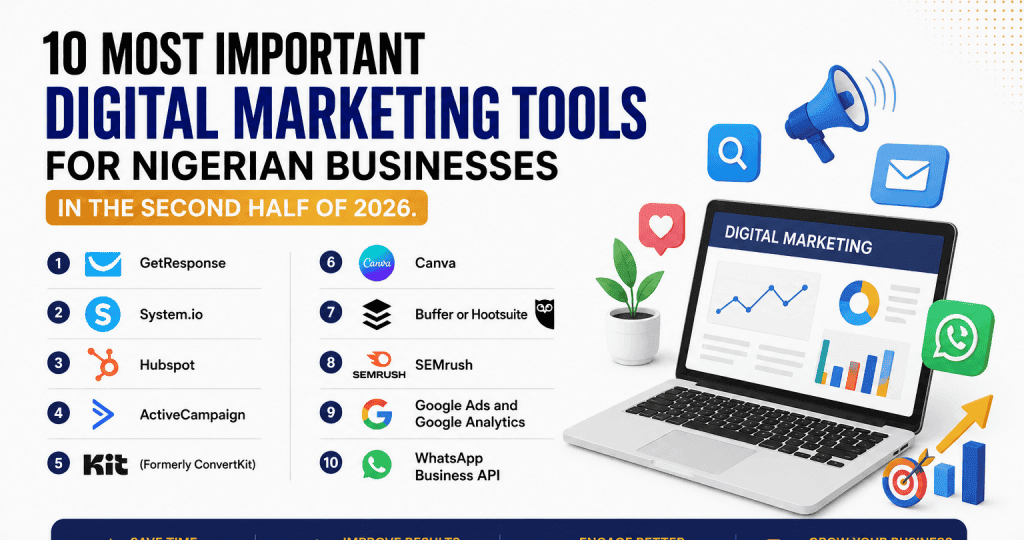
- GetResponse
- System.io
- Hubspot
- ActiveCampaign
- Kit (Formerly ConvertKit)
- Canva
- Buffer or Hootsuite
- SEMrush
- Google Ads and Google Analytics
- WhatsApp Business API
I will explain what each tool does, why it is particularly relevant to our market, and what you can realistically expect to pay for them
Top 10 Digital Marketing Tools Nigerian Businesses Should Know in 2026
1. GetResponse: Best Overall All-in-One Marketing Platform
If you’re currently using four or five separate tools for email marketing, landing pages, webinars, and automation, you should definitely consider GetResponse. This platform combines all these functions into a single solution, which is especially beneficial for Nigerian businesses that are closely monitoring their expenses. With fewer subscriptions to manage, you only need one login and one support relationship.
What sets GetResponse apart in the Nigerian context is its impressive email deliverability. It boasts an 89.2 percent inbox rate, a significant advantage in a market where many emails can end up in spam folders. This is particularly valuable for businesses running lead generation campaigns or sending out regular newsletters to their client lists.
Additionally, GetResponse includes webinar hosting, which has become increasingly important for consultants, coaches, and training organizations in Nigeria looking to build their online audiences.
2. Systeme.io: For Digital Product Sellers and Course Creators
If you sell digital products, offer online courses, or run an affiliate program, Systeme.io is one of the most cost-effective platforms available for Nigerian entrepreneurs today.
Unlike many other similar platforms that charge transaction fees in addition to monthly subscription costs, Systeme.io has zero transaction fees. This can lead to significant savings over time for Nigerian creators and educators who frequently process sales.
Systeme.io includes features for sales funnels, email marketing, course hosting, affiliate management, and basic automation, all within one convenient platform. This makes it accessible and affordable for early-stage businesses.
The starting price is approximately ₦18,000 per month for up to 5,000 contacts, making it ideal for digital product sellers, course creators, and coaches looking to develop online programs.
3. HubSpot: Good for B2B Businesses and Sales Teams
When it comes to B2B sales cycles, especially for Nigerian organizations, HubSpot is my go-to recommendation. This platform works wonders for businesses that sell to other businesses rather than individual consumers.
What I find particularly impressive about HubSpot is how seamlessly it integrates your marketing efforts with your sales pipeline. You can pinpoint exactly which content your leads interacted with before they turned into inquiries, which campaigns are driving the most qualified prospects, and identify where leads might be dropping off in the sales process.
For many Nigerian companies, there’s often a disconnect between sales and marketing teams. HubSpot helps bridge that gap by providing transparency and shared visibility. Plus, it offers a free CRM that’s packed with value, and if you decide to go for the paid version, it’s definitely worth it when you’re ready to dive into more advanced marketing automation.
The pricing starts around ₦65,000 per month for up to 5,000 contacts, making it a great fit for B2B companies, professional services firms, and corporate sales teams looking for an effective way to manage their client relationships and marketing strategies.
4. ActiveCampaign: For Complex Customer Journeys
ActiveCampaign is definitely a game-changer for businesses that see customer relationships as a long-term journey instead of just a one-time transaction.
If your business deals with multiple product lines, has a lengthy decision-making process, or guides customers through various stages before they make a purchase, ActiveCampaign has the automation tools you need. It helps create communication sequences that feel personalized and perfectly match each customer’s unique journey.
Take, for instance, a Nigerian insurance company, a professional services firm, or a B2B training provider. These businesses can use ActiveCampaign to automatically deliver tailored content to different types of contacts, whether they’re just starting to explore options, warming up to a decision, making their first purchase, or returning for more.
With a starting price of around ₦35,000 per month for up to 5,000 contacts, it’s a fantastic option for businesses that navigate complex sales processes, have subscription models, or offer a variety of products.
5. Kit (Formerly ConvertKit): A Starting Point for Email Marketing Beginners
If you’re diving into email marketing for the first time and have a small list, I highly recommend giving Kit a try. It’s super beginner-friendly, making it a great starting point for entrepreneurs in Nigeria who want to send out regular newsletters, gather email subscribers from their websites, and run occasional promotional campaigns.
Think of Kit as your launchpad; it may not be the most powerful tool out there, but it’s perfect for getting you off the ground. As your email list grows and your marketing strategy evolves, you might find that you need a more advanced platform down the line. But starting with Kit? That’s a fantastic move. It’s definitely better to take that first step than to hold back on your email marketing journey!
6. Canva: The Content Creation Tool Every Nigerian Marketer Already Needs
In many Nigerian marketing teams, you’ll often find Canva at the forefront. This platform has become a beloved creative tool for whipping up everything from social media posts and ad graphics to presentation decks and various brand materials. It’s hard to overstate just how essential it’s become to visual content creation.
What makes Canva so popular? For starters, it’s fast and easy to use, even on mobile devices. Plus, you don’t need to have graphic design skills to produce high-quality visuals, which is a huge advantage for those just starting out.
For small and medium-sized enterprises (SMEs) and entrepreneurs in Nigeria, Canva is not just a luxury; it’s a necessity. Many of these businesses can’t afford to hire a full-time designer but still need to create consistent and professional-looking content. Canva fills that gap beautifully.
The free version can handle most needs, and if you’re looking for extra features, the paid version comes with perks like brand kit management, a wider variety of templates, and team collaboration tools. These can be especially beneficial as your content demands grow.
The free tier is a great starting point, while the paid plans begin at around ₦3,000 per month, a token for small businesses compared to hiring a professional graphics designer. Given that virtually every Nigerian business is in the business of creating visual content, Canva truly stands out as a smart choice for those looking to elevate their brand without breaking the bank.
7. Buffer or Hootsuite: For Social Media Scheduling and Performance Tracking
Staying consistent with social media marketing can feel like a daunting task, especially when life gets busy and deadlines start piling up. It’s easy for weeks to slip by without any new posts.
That’s where social media scheduling tools come in handy. By letting you create content ahead of time and schedule it for multiple platforms, these tools can take the stress out of posting, giving you more time to tackle other important tasks.
For smaller teams or businesses just starting out, Buffer is a fantastic and budget-friendly choice. It’s straightforward and perfect for managing a few platforms without breaking the bank. On the other hand, if you’re running multiple brand accounts or need to coordinate a larger team, Hootsuite is worth considering. It comes with more advanced features and analytics, but that comes at a higher price.
For many small and medium-sized enterprises (SMEs) in Nigeria, Buffer is likely the best starting point. You can always transition to Hootsuite as your business grows and your social media needs become more complex.
To give you an idea of costs, Buffer starts at around ₦5,000 per month, while Hootsuite begins at about ₦15,000 per month. Both tools are designed for businesses that want to maintain a steady social media presence without the hassle of posting manually every day.
8. SEMrush: For Nigerian Businesses That Want to Win on Google
If organic search is a central part of your growth strategy, meaning you want potential customers in Nigeria to find your business on Google without having to pay for each click, SEMrush is an invaluable tool to have at your disposal.
With SEMrush, you can uncover the exact keywords that your ideal customers are typing into search engines, analyze what your competitors are ranking for, conduct a thorough audit of your website to spot technical SEO issues, and plan content that has a real shot at visibility.
For Nigerian businesses that are investing in blog posts, articles on LinkedIn, or improving website SEO, trying to manage without a tool like SEMrush is like trying to navigate through the bustling traffic of Lagos without Google Maps. Sure, you might eventually make it to your destination, but chances are you’ll waste a lot of time and take plenty of wrong turns along the way.
9. Google Ads and Google Analytics: The Non-Negotiable Tools
If you’re running a serious business in Nigeria and diving into digital marketing, you definitely want to get familiar with two key tools that can really make a difference: Google Ads and Google Analytics.
First off, Google Ads is a game-changer. It puts your business in front of people who are actively searching for what you offer. Instead of reaching out to those who might have a passing interest, you’re engaging with potential customers who are already looking for your products or services. This targeted approach is vital for generating leads and driving sales.
Then there’s Google Analytics, which is like a treasure chest of insights about your website. It helps you understand where your visitors are coming from, what pages they’re checking out, where they tend to drop off, and whether your marketing efforts are actually leading to the actions you want, whether that’s signing up, making a purchase, or something else.
When you use these two tools together, you gain real visibility and control over your marketing strategy. It allows you to make informed decisions based on data rather than just guesses.
The best part? Google Analytics is completely free to use, while Google Ads operates on a pay-per-click basis, meaning you can manage your costs based on your specific advertising efforts and budget. This combination makes it easier to tailor your marketing strategy effectively.
10. WhatsApp Business API: Nigeria’s Most Powerful Direct Marketing Channel
Nigeria boasts one of the highest rates of WhatsApp usage in the world, with many people turning to the platform every day. In fact, for many, it’s a more frequent choice than any other social media app. Businesses in Nigeria can tap into this potential through the WhatsApp Business API, offered by local providers like Termii and SendChamp. This powerful tool goes beyond the regular WhatsApp Business app, enabling companies to utilize features such as broadcast messaging, automated replies, product catalogs, and even chatbots, scaling their interactions and customer service to new heights.
For many Nigerian businesses, this is more than just a communication tool; it’s essential for customer retention, running promotional campaigns, providing order updates, and supporting customers. Whether it’s for direct selling or enhancing customer support, WhatsApp has become indispensable in the daily operations of commerce across the country.
While costs can differ depending on the provider and volume of messages, it’s clear that every Nigerian business aiming for success in direct-to-consumer sales should consider incorporating this powerful tool into their strategy.
How to Choose the Right Tools for Your Business
If you’re looking to simplify your subscriptions and switch to just one platform, you might want to check out GetResponse or Systeme.io. Both of these options bundle several tools into one affordable price, making things easier on your budget.
For businesses that operate in the B2B space or have dedicated sales teams, HubSpot or ActiveCampaign can really streamline your processes. Combining CRM and marketing automation can lead to impressive growth results.
If you’re new to email marketing, Kit is a great starting point. It’s user-friendly and makes setting up your campaigns a breeze. Just keep in mind that as your subscriber list expands and your strategy evolves, you may need to transition to a different platform down the line.
For those creating social media content every day, using Canva alongside Buffer is a solid combo for both design and scheduling. This partnership is budget-friendly and works well for many teams in Nigeria.
If driving organic search traffic is essential for your business, consider pairing SEMrush with Google Analytics. Together, they can provide valuable insights to help you craft content that not only ranks well but also measures its performance effectively.
Finally, if your primary customers are individual consumers in Nigeria, activating the WhatsApp Business API should be at the top of your list. It’s proven to be one of the most effective channels in today’s tech landscape.
One Final Thing Before You Subscribe to Any Tool
In 2026, it’s clear that the Nigerian businesses thriving in digital marketing aren’t necessarily those boasting the most subscriptions. Instead, the real winners are those who take a more mindful approach, selecting a few powerful tools, truly understanding how to maximize their potential, and creating consistent systems to make the most out of them.
Take GetResponse, for instance. If a business invests ₦12,000 per month in this tool and uses it wisely by targeting a specific audience, crafting a thoughtful email marketing strategy, and generating content that genuinely resonates, it can yield impressive results. On the flip side, spending ₦150,000 a month on various tools without a clear strategy can lead to disappointing outcomes.
While having the right tools is important, the strategy driving them is even more critical. Getting the strategy right is the first step, and from there, you can build a toolkit that aligns with your goals.
If you’re looking for help figuring out the right combination of tools for your business or need guidance in crafting a digital marketing strategy that your tools can effectively implement, I’d love to connect! Feel free to reach out on LinkedIn or send me a direct message.
I’m David Alonge, a digital marketing strategist and corporate training consultant, and I founded Adatech Global Edge, a digital marketing consultancy and training firm dedicated to helping businesses and organizations across Nigeria succeed.