

If you ask ten Nigerian business owners about their marketing strategy and what does their marketing funnel looks like, most of them will list various activities. They might say things like, “We post on Instagram every day,” “We occasionally run Facebook ads,” “We have a WhatsApp group for our customers,” or “We just started using LinkedIn.”
These are activities, but not a strategy. A real strategy is a system with a beginning, middle and end. It takes a stranger, never heard of your business on a defined journey, ultimately converting them into a paying customer, ideally a repeat one.
This structured approach is known as a funnel. In 2026, the lack of a clear funnel will be one of the main reasons why Nigerian businesses spend money on marketing without seeing it translate into sales.
This article will explain what a digital marketing funnel is, why many Nigerian businesses lack one even when they believe they have it, and provide a practical framework you can use to build a funnel for your business starting this month.
What a Digital Marketing Funnel Actually Is
A digital marketing funnel is the path a potential customer travels from the first time they encounter your business to the moment they make a purchase decision, and beyond.
It is called a funnel because it is wide at the top and narrow at the bottom.
At the top of the sales funnel, many people become aware of your business. As they move through the funnel, the number of people decreases, as not everyone who notices you is ready to buy. By the time you reach the bottom, you’re left with a smaller group of individuals who are genuinely ready to become customers.
The role of your marketing is not to push everyone down the funnel all at once. Instead, it should guide the right people through each stage, providing them with the appropriate content at the right time.
This is where many Nigerian businesses go wrong. They create content as if every person viewing it is already at the bottom of the funnel, ready to make a purchase immediately. A post goes up, and it’s a direct sales pitch that includes the price and has a call to action like “buy now” or “order today.”
However, most people who see that post for the first time are probably not prepared to buy. They do not know you yet, they do not trust you yet, and they have not been convinced that you understand their problems.
When your content speaks only to the bottom of the funnel, you lose everyone who isn’t already there. And for most businesses, that is the overwhelming majority of your audience.
The Three Stages of a Digital Marketing Funnel (And What Nigerian Businesses Get Wrong at Each One)
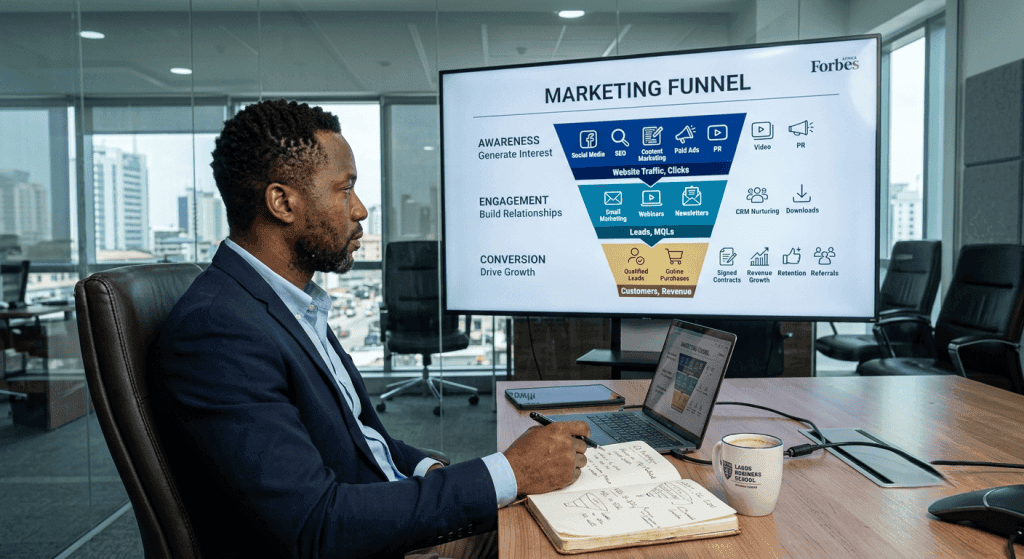
Stage 1: Awareness — “I did not know this business existed.”
This is the top of the funnel, and the objective is straightforward: attract the right audience so they notice your existence.
One common mistake made by many Nigerian businesses at this stage is trying to make a sale too quickly. A stranger who happens to come across your page isn’t yet interested in your product; they are focused on their own needs, problems, and goals.
Content created for the awareness stage should hold value in its own right, regardless of whether it promotes your product. It should aim to educate, entertain, or provide insights that your target audience finds genuinely useful.
At this stage, effective examples for Nigerian businesses include a post from a fashion brand discussing how they created a design for an outfit, or a short video sharing an industry insight on the new technology adopted by FMCG company to come up with their product, or a piece of content that showcases a sales consultant’s expertise on a topic relevant to your audience.
The aim at this stage is clear: make the right person pause their scroll and think, “This is someone who understands my situation.”
Stage 2: Consideration — “I know this business exists. But why should I choose them?”
This is the middle of the funnel, and it is the stage most Nigerian businesses skip entirely.
Many brands go directly from promoting their identity to urging customers to “buy now.” However, people in the consideration stage have different questions. They want to know more. They are comparing options and seeking to understand what sets your brand apart. They want to know if you are credible and if others like them have successfully worked with you in the past.
Content aimed at the consideration stage should focus on building trust and providing evidence of your credibility.
Examples that work well for Nigerian businesses at this stage:
→ Case studies and client results, even simple ones such as the story of how a customer got his problem resolved through your product or service
→ Behind-the-scenes content that shows how you work things out and what resources are involved in getting them done
→ Testimonials and social proof from people in similar situations to your audience
→ Content that addresses common objections directly, such as “Is this worth the cost?” or “How is this different from [the alternative]?”
The goal at this stage is to move the right person from “I have heard of them” to “I trust them enough to consider working with them.”
Stage 3: Conversion — “I am ready. What do I do next?”
This is the bottom of the funnel, and it is the only stage where most Nigerian business content actually operates.
The issue isn’t that businesses sell at this stage; they should. The real problem is that the conversion path is often unclear, complicated, or hidden.
Content at the conversion stage should make the next step obvious and easy.
Examples that work well for Nigerian businesses at this stage:
→ A clear, direct offer with a simple way to act, such as “Send us a message,” “Click the link to book a call,” or “Comment below and we will reach out”
→ Limited-time offers or bonuses that create a reason to act now rather than later
→ A simple, low-friction first step, such as a free consultation, a sample, or an audit
The goal at this stage is to remove every possible point of friction between someone deciding they want to work with you and them actually being able to do so.
Why Most Nigerian Businesses Only Have a Conversion Stage
Here is the honest reality I observe across most Nigerian businesses I work with:
Approximately 80 percent of their content focuses on the conversion stage with phrases like “Buy now”, “Book today”, “Limited slots available”, and “DM us to order”. In contrast, less than 10 percent is dedicated to the consideration stage, and nearly none addresses the awareness stage.
This approach is like walking up to every stranger on the street and proposing marriage. No matter how compelling the proposal may be, the relationship has not been established yet.
This is why many Nigerian businesses describe their marketing efforts as “not working”, even though they are engaged in marketing activities every day. They are focused on one part of the marketing funnel, specifically the awareness or conversion stage, but they are only addressing one-third of the entire process. This part requires the most trust, which hasn’t yet been built with their audience.
A Practical Framework on How to Build Your Funnel
You do not need a complicated system or expensive software to build a working funnel. All you need is clarity and consistency. Here are practical steps you can use in building an effective funnel for your marketing and sales
Step 1: Map your customer’s journey before you map your content.
Before deciding what to post, get clear on the journey your ideal customer actually takes. Like: What do they not know about their problem before they meet you? What do they need to believe before they trust you? What is the simplest first step they can take with you?
Step 2: Audit your last 30 days of content against the three stages.
Go through everything you posted in the last few months. For each piece of content, ask: is this awareness, consideration, or conversion content? Most Nigerian businesses will find that almost everything falls into one category or no category at all. That imbalance is your starting point to getting it right and moving forward.
Step 3: Build a content mix, not a content list.
A healthy weekly content mix for most Nigerian businesses looks roughly like this: for every 5 to 7 pieces of content, 2 to 3 should be awareness content, 2 should be consideration content, and 1 to 2 should be conversion content. This ratio will shift depending on your industry and audience, but the principle holds: the bulk of your content should earn attention and trust, not just ask for the sale.
Step 4: Give every piece of content one clear job.
A single post should not try to educate, build trust and sell all at once. That confuses both your message and your audience. Decide what stage a piece of content is serving before you create it, and let it do that one job well.
Step 5: Track what moves people between stages, not just what gets likes.
Likes and views tell you about awareness. Saves, shares, profile visits and DMs tell you about consideration. Inquiries, bookings and sales tell you about conversion. If you are only tracking the first set of numbers, you have no visibility into whether your funnel is actually working.
Why a Digital Marketing Funnel Matters More in 2026 Than Ever Before
Nigerian buyers, whether individual consumers or corporate decision-makers, are more informed and skeptical than they were just two years ago. They have been exposed to more advertisements, pitches, and “limited time offers” than any previous generation.
Attempting to skip straight to the sale in this environment not only fails to convert, but can also harm your brand’s image.
The businesses that will establish the strongest customer relationships and generate the most revenue in the coming years are those that view marketing as a journey rather than just a transaction.
A sales funnel is not just a marketing buzzword; it’s a framework for genuinely helping people before asking them to make a purchase. In 2026, this approach will be essential. It will distinguish between a business that is merely busy and one that is truly growing.
What to Do Next
If going through these three stages made you realize that your content is focused in one area, that’s not a failure, it’s a sign of clarity, and clarity is the foundation for everything else.
I collaborate with businesses and corporate teams across Nigeria to develop digital marketing strategies and funnels tailored to how their actual customers think and behave, rather than relying on generic templates. If you would like assistance in auditing your current content against this framework and creating a funnel that aligns with your business, please connect with me on LinkedIn or send me a direct message.
David Alonge is a Digital Marketing Strategist and Corporate Training Consultant. He is the founder of Adatech Global Edge, a digital marketing consultancy and training firm working with businesses and organisations across Nigeria.