
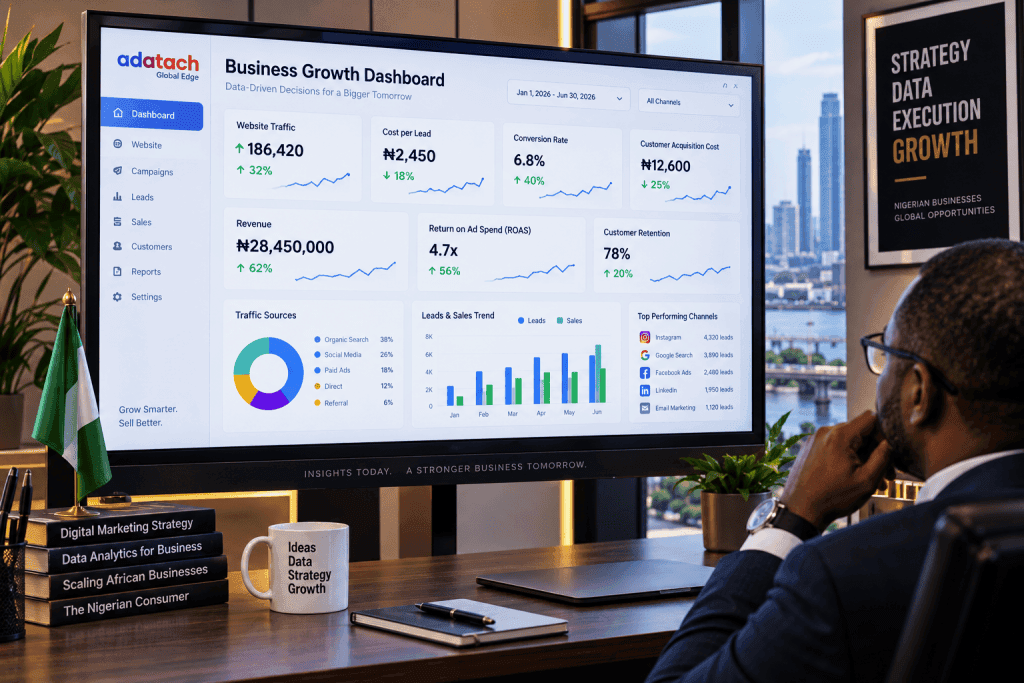
Recently, I interacted with a client who was building a brand in a rare niche. She was looking for us to create landing page copy, rebrand her website, capture campaign leads, and develop content pillars, all without first establishing a foundational digital growth strategy following our usual audit. When she laid out everything she wanted to work on, I explained to her in relatable terms that you can’t have a solid duplex without a strong foundation and structure.
This is where I see many businesses miss the point. Social media posts often go out randomly, usually when someone happens to remember, and websites can sit untouched for years after their launch. Ad campaigns run for just a couple of weeks, and when the budget officer asks about their performance, nobody has a clear answer. This isn’t a real strategy; it’s just a collection of isolated activities that might happen to be online. What we really need is a genuine digital growth strategy.
This means bringing together SEO, paid media, content, and automation, all with a focus on one key goal: increasing your revenue, in naira or dollars in some cases. Forget the vanity metrics that look great on a screenshot but don’t translate to real success.
This approach is about creating a practical roadmap designed for how Nigerian businesses and customers truly operate. It’s time to connect the dots and create a strategy that drives real growth!
Why You Need a Structured Digital Growth Strategy
You will agree with me that Nigeria’s digital adoption keeps accelerating. Starting from the Nigeria federal government’s continued push around digital infrastructure to MSME support, alongside growing bank involvement in digital tools for small businesses, is part of a broader effort to grow the country’s digital economy meaningfully over the next few years.
Underneath that broader push sits a simple, unavoidable reality for any Nigerian business owner. Your customers already spend a meaningful part of their day on their phones, comparing you against competitors, checking reviews, and, very often, expecting to reach you on WhatsApp rather than through a contact form on your website. If your business is not built around that reality, you are marketing to a version of your customer that no longer exists.
A structured digital growth strategy answers three questions plainly: Which channels actually bring paying customers for your specific business? How much should you realistically be spending each month in naira? And how do you turn a click or a visit into an actual WhatsApp conversation and, eventually, a sale?
We will explore these questions and more through four key structures that truly matter in creating an effective digital growth strategy.
Structure 1: SEO Built for the Nigerian Market
The “global best practice” SEO advice will only make it harder and even costlier for Nigerian businesses to scale through. Like I always tell some of our international clients looking into the Nigerian market, what actually moves the needle here looks different in the international world. And that is what we are looking at here:
Mobile-first and data-conscious performance.
The majority of your customers browse on Android or iOS devices rather than laptops. It is estimated that Nigeria has between 96.27 million and over 140 million smartphone users. This means that a slow, heavy website loses both search rankings and patience with the average Nigerian. Compressing your images, removing unnecessary scripts, and testing your site on a 3G or 4G connection can all help, rather than assuming your office Wi-Fi reflects reality.
Local intent keywords are paramount. Nigerian searchers are specific. For instance, “Best digital marketing agency in Lagos” performs differently than “digital marketing agency.” “Corporate training companies in Nigeria” captures intent that “corporate training” alone does not. Build content deliberately around these local, problem-specific phrases.
Your Google Business Profile is more important than many businesses understand. During my consulting sessions, I emphasize this to my clients because it’s astonishing how many deals are being closed through GBP. For service-based businesses, it’s crucial to fill out every section, select the appropriate categories and service areas, and sincerely invite reviews from actual clients. This effort significantly impacts your visibility when potential customers nearby search for your services.
When creating content, think about clustering your topics together. Instead of randomly writing a blog post here and there whenever you feel inspired, focus on building a complete content cluster around the questions that your ideal customer is asking. I’ve detailed this structured approach in one of my earlier posts, titled “The Digital Marketing Funnel Every Nigerian Business Must Build.” Start each piece with a clear answer to the question in the title; this method is effective because it aligns with how AI tools like ChatGPT and Google’s AI Overview pull information.
Now, if we’re talking about SEO support in Nigeria, costs can really vary based on what you need. For small businesses, you might come across modest monthly retainers. On the other hand, if you’re looking for more extensive services, you could be looking at figures in the high hundreds of thousands of naira. Just remember, any quotes you see online are usually starting points for discussion, not a final figure. This way, you can find something that actually meets your particular needs.
Structure 2: Paid Media That Works With Naira Budgets
If you’re working with a fixed advertising budget, be cautious because it may leave you vulnerable to unpredictable exchange rate fluctuations that could affect your financial stability. Instead, consider planning your budget in naira and testing it against potential currency shifts to ensure you’re prepared.
When determining your costs, don’t start by asking, “How cheaply can I reach my audience?” Instead, consider your business from a different perspective: What is a qualified lead really worth to you? What is the lifetime value of your average customer, and how many leads do you typically need to close a sale? For example, if a customer generates ₦100,000 and you close about one out of every five leads, then each lead is worth approximately ₦20,000. This figure should guide your campaigns rather than a random daily budget.
It’s also important to match the right platform to your audience’s buying habits. Meta can be effective for reaching a broad audience and nurturing potential customers, especially if you direct clicks to a WhatsApp chat instead of sending people to a cold landing page. Google Search, on the other hand, typically captures individuals who are already searching for solutions, indicating they are more motivated, though this often comes with a higher cost per click, particularly in competitive fields like finance or legal services. Moreover, TikTok tends to work well for younger, consumer-focused brands and generally offers lower costs for reach than Meta, although its measurement tools are still evolving.
Keep in mind that actual costs on these platforms fluctuate constantly based on your industry, targeting, and the time of year. Therefore, treat any specific figures you encounter as rough estimates rather than guarantees. It’s a good idea to run a small test first, see what you end up actually paying, and then build your budget around those real numbers.
Structure 3: Content That Actually Converts
Lead with the answer, then explain. Structure your content around the specific questions your buyers are already typing into Google or asking an AI assistant. “How much does {your product or service} cost in Lagos?” “Is this safe to use {your product or service} in Nigeria?” Open each piece with a short, direct answer before you go into detail. This performs better in traditional search, and it is far more likely to be the exact passage an AI tool pulls into a generated answer.
Try to localize everything, genuinely. It’s crucial you speak in a language that easily connects locally. Mentioning each location by its name like Lagos, Abuja, Kano, Port Harcourt will work better rather than by using generic words like “major cities.” Point out real references to things relatable like fuel costs, delivery timelines, and epileptic power supply or NEPA. Content that clearly reads as written for Nigerians, by someone who actually understands Nigerian business, earns trust faster than anything polished but generic ever will.
Use short-form video for discovery. Reels, Shorts, and TikTok remain where a lot of Nigerian audiences discover a business for the first time in 2027. Repurpose your existing long-form content into tight, 30 to 60-second explainers, and always add captions, since a large share of your audience will watch with the sound off.
Build trust content deliberately. Real testimonials, founder stories, and behind-the-scenes glimpses of how your team actually works. In a market where trust is earned slowly, this content shortens the distance between someone discovering you and someone actually messaging you.
Structure 4: Automation and a WhatsApp-Centered Sales Process
WhatsApp has become a central hub for customer conversations in Nigeria, playing a crucial role before, during, and after sales interactions. While I’m hesitant to provide a specific open-rate percentage since the often-quoted “95 percent plus” figures are largely based on marketing vendors referencing each other without solid, independent evidence, what remains clear is the reality of the market: if your sales process doesn’t integrate WhatsApp, you’re likely losing out to competitors who do.
To maximize WhatsApp’s potential without needing an enterprise budget, consider implementing a straightforward automation stack. Start with a complete WhatsApp Business profile that features your product catalog, an automated greeting, and quick replies for the most frequently asked questions. This sets a professional tone and ensures that common queries are handled efficiently.
You can further enhance your operations with a basic customer relationship management (CRM) system. This doesn’t need to be fancy; even a shared spreadsheet can serve as a good foundation. Use it to track each lead’s source, current stage, and next follow-up date. Tools like Zapier or Make can simplify your workflow by automatically transferring form submissions and ad leads directly into WhatsApp and your CRM.
Next, create a simple nurture sequence. When someone reaches out, respond with an instant, warm greeting, followed by two or three qualifying questions to gauge their budget and timeline. After that, guide them with a clear next step, whether it’s scheduling a call, a demo, or a site visit. If they go quiet, plan to send two or three genuinely valuable follow-up messages spaced over two weeks, rather than a single, desperate “still interested?” text.
By adopting these strategies, you’ll harness the power of WhatsApp to drive sales and nurture leads effectively, ensuring your business remains competitive in the marketplace.
A 90-Day Plan to Put This Together

Days 1 to 15: Laying the Groundwork
Start by reflecting on your current business setup. Be candid about your website, payment options, and the customer relationship management (CRM) tools you’re currently using. This is also an ideal moment to ensure your WhatsApp Business and Google Business profiles are fully optimized. If you haven’t done so yet, consider adding basic analytics to gain insights into your website’s performance.
Days 16 to 45: Getting Things Rolling
Now it’s time to launch your core channels. Focus on fixing the parts of your website that could be driving customers away, especially speeding up mobile loading times and adding a WhatsApp button on every page for easy access. Aim to create 5 to 10 pieces of content that directly answer your potential customers’ questions. Start with some small, targeted paid tests aimed at generating conversations rather than just aiming for broad reach.
Days 46 to 90: Fine-tuning Your Approach
During this phase, think about how you can connect everything and make it more efficient. Automate the process of capturing leads through WhatsApp and your CRM to streamline your workflow. Consider retargeting ads for visitors who checked out your site but didn’t make a purchase. Be sure to take a close look at your actual costs for leads and sales in naira. Adjust your budget to focus on what’s really working instead of what seems like it should work.
By day ninety, you should ideally have a system that’s up and running. You’ll have traffic coming in, leads flowing through to WhatsApp, and a clear understanding of what’s genuinely driving profits.
Managed Digital Team or Freelancers: What Actually Holds Up Long Term
This is a decision most growing Nigerian businesses eventually face, and the freelancer route often looks cheaper on paper than it turns out to be in practice.
With separate freelancers, you typically end up with an SEO person who has never spoken to your ads person, a content writer with no real visibility into your sales process, and nobody who owns the full picture from first click to closed sale. When a freelancer moves on, whatever context lived in their head usually leaves with them, and you are back to re-briefing someone new from scratch.
A properly managed digital team removes that fragmentation. One strategy, one set of shared goals, and institutional knowledge that stays with your business instead of walking out the door. I laid out the full financial comparison between building this in-house, hiring freelancers piecemeal, and working with a managed team in The Real Cost of Hiring a Full-Time Digital Marketer in Lagos
This is the model we operate on at Adatech, which I think of as Digital Workforce as a Service: a coordinated team functioning as an extension of your leadership, not a rotating cast of contractors you have to constantly manage yourself.
| Piecemeal Freelancers | Managed Digital Team | |
| Strategy ownership | Fragmented, no single owner | One owner, one documented plan |
| Coordination | Siloed, disconnected efforts | Integrated across SEO, paid, content and automation |
| Consistency | Depends entirely on the individual | Process-driven, backed by a team |
| Institutional knowledge | Leaves when the freelancer does | Retained within the team and your systems |
| Cost at scale | Often hidden in wasted spend and your own management time | Predictable, tied to outcomes |
For a business genuinely serious about scaling online in 2027, this is not a luxury upgrade. It is closer to core infrastructure.
Frequently Asked Questions
What is a digital growth strategy for a Nigerian business?
It is a structured plan combining SEO, paid media, content, and automation to acquire and retain customers online, built specifically around naira budgets, mobile-first behaviour and WhatsApp-driven sales conversations, rather than a generic global template.
How much does digital marketing cost in Nigeria?
It varies significantly by scope, but as a rough planning range, expect SEO support from a modest monthly retainer up into six figures for a comprehensive engagement, and social media management typically in a similar range. I broke down the full real cost, including the costs most businesses forget to budget for
Which digital channels matter most for Nigerian SMEs?
For most Nigerian small and medium businesses, Google Search, Meta advertising, WhatsApp Business, and short-form video consistently deliver the most impact, supported by a genuinely fast, mobile-friendly website.
Should I hire freelancers or work with a managed digital team?
For anything beyond a single short-term project, a managed team generally outperforms piecemeal freelancers, because it provides coordinated strategy and shared accountability across channels, rather than fragmented execution that nobody fully owns.
If you are ready to build this properly for your business rather than improvise it channel by channel, connect with me on LinkedIn or send me a direct message.
Its Amazing